Snippet Hive
Co-founded and engineered an AI-powered code snippet manager that synchronizes code blocks across a web app, a VS Code extension, and a Chrome extension.

The Problem
Developers using AI coding models often waste significant time regenerating or looking for past code templates (such as auth setups, helper configurations, or visual component structures). Without a team-wide repository integrated into their active tools, snippet discovery remains a persistent productivity leak.
My Role
- →Co-founded the platform, leading front-end architecture and API contract design.
- →Engineered the core web repository interface and snippet storage system.
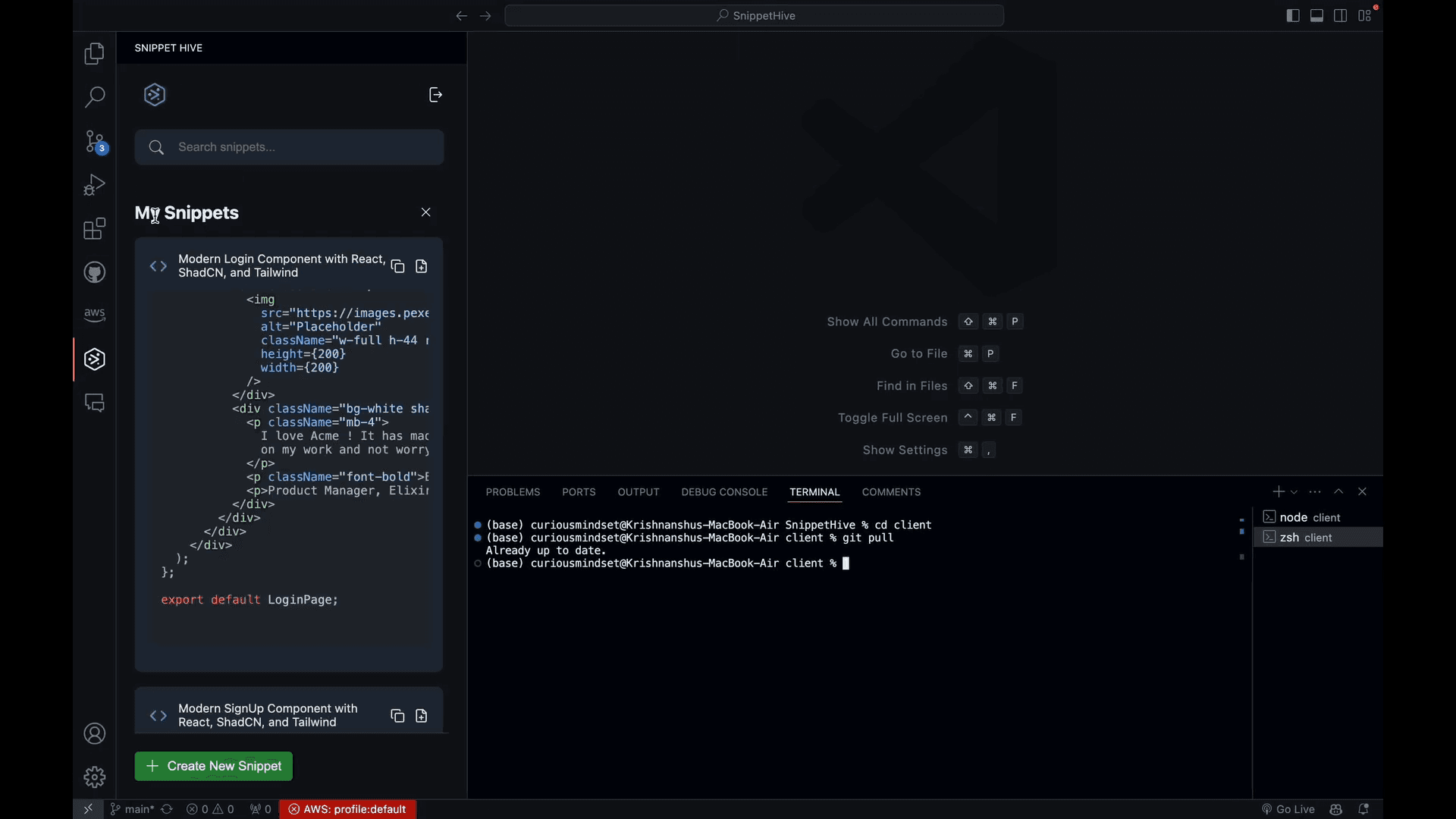
- →Developed the custom VS Code extension leveraging the editor API to support inline snippet inserters.
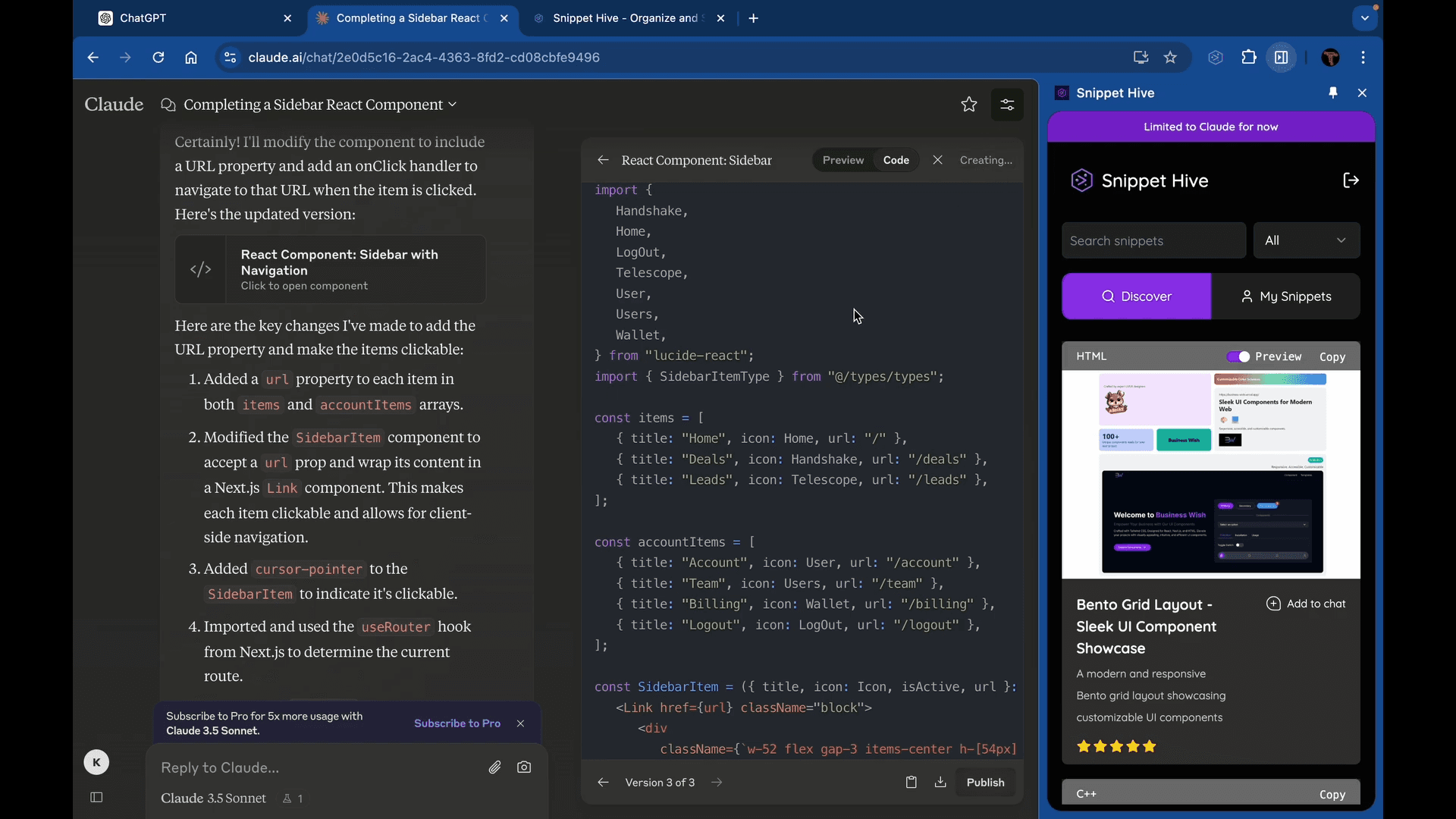
- →Built the Chrome extension to enable developers to save chat outputs directly from ChatGPT or Claude.
The Solution
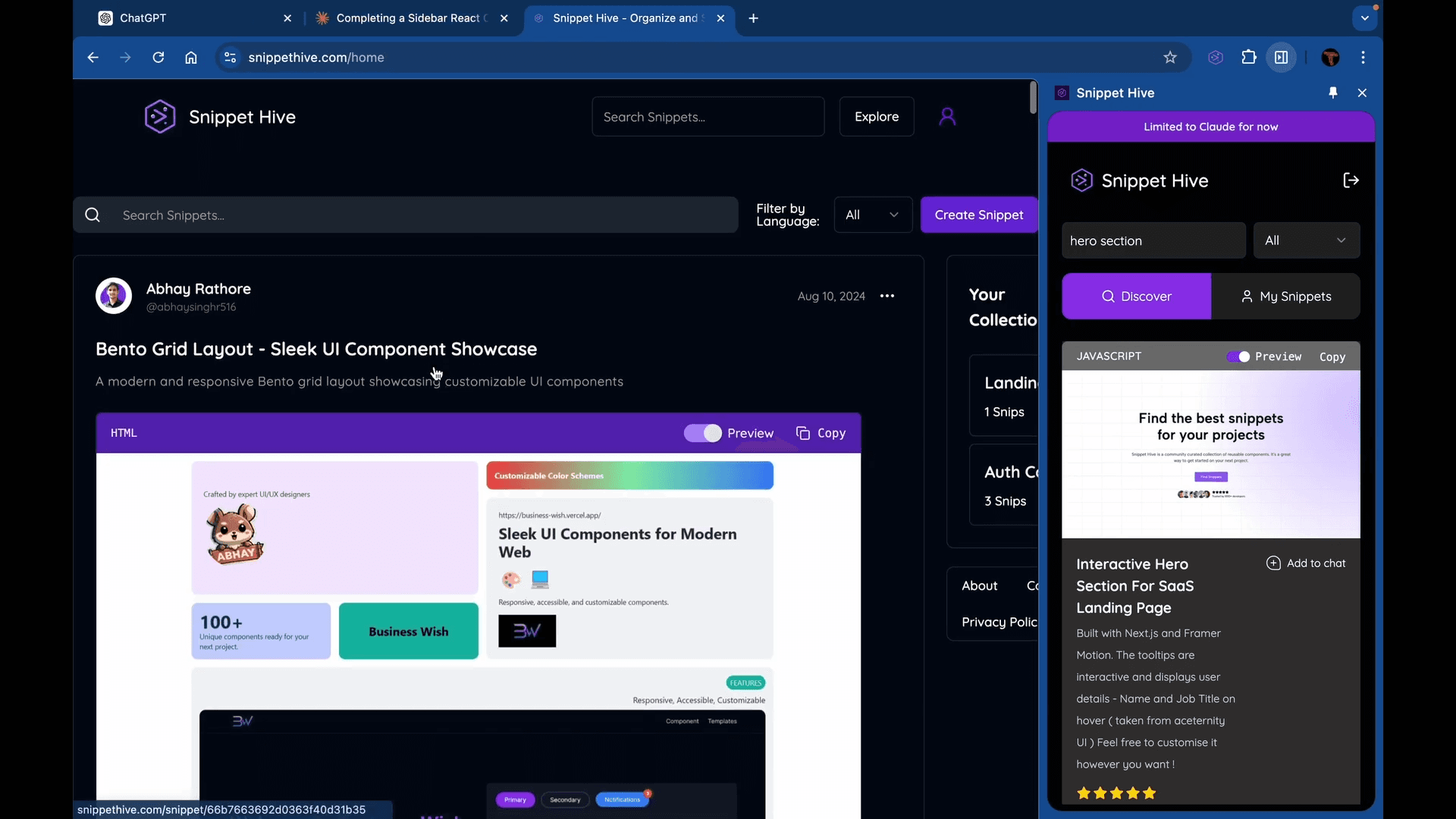
We built Snippet Hive — a collaborative code vault. Instead of operating purely as a web catalog, it extends directly into the developer's workspace. By writing native VS Code and Chrome integrations, we closed the loop between discovering a snippet in chat, storing it, and retrieving it directly inside the IDE.
Technical Decisions
Why Next.js?
Next.js was selected for the primary web platform because it allowed us to build the public catalog pages via static site generation (SSG) for SEO while using client-side rendering (CSR) for the private user dashboards, keeping deployment simple.
Why MongoDB?
Since code snippets vary widely in language structures, metadata attributes, and user-defined tags, a document database allowed us to modify schema fields on the fly during our rapid 6-week validation cycles.
Custom JWT Auth
We implemented a custom stateless JWT token-exchange flow to seamlessly authenticate the user's workspace inside the VS Code editor context without forcing them to manually copy-paste token hashes.
State management
Zustand was implemented for client state management. Its minimal footprint and clean hooks-based API eliminated Redux boilerplate while maintaining excellent rendering speeds.
What Broke
Our biggest challenge was engineering the real-time offline sync mechanism. Developers frequently edited snippets offline or across multiple environments concurrently, leading to synchronization conflicts. Initially, we faced write race conditions. To resolve this, we scrapped our naive timestamps in favor of a centralized conflict resolution layer modeled after Last-Write-Wins (LWW) register logic, ensuring consistent state updates.
Key Outcomes & Metrics
- →Successfully built and deployed the full product suite (web registry, VS Code extension, and Chrome extension) within a tight 6-week timeframe.
- →Achieved 100% faster snippet lookup times for early users compared to their previous manual search or regeneration workflows.
What I'd Do Differently
“If we were to rebuild this project today, we would replace the manual tagging system with automated vector embeddings. Relying on developers to tag their snippets is a high-friction request. Having an AI run semantic searches on snippet code bodies and natural language descriptions would have enabled frictionless, automated code discovery.”
Get In Touch
Always open to a chat, whether it's about an idea, a collaboration, or just an interesting conversation. Particularly interested in fast-moving teams solving exciting problems in AI, SaaS, developer tools, and enterprise software. Say hi anytime!